Blog
The Gifted Gap: Why the Students Who Belong in the Room Are Not in the Room
Underrepresentation in gifted and advanced programs is not a pipeline problem. It is an identification and advocacy failure. And it has a face.
~Dr. Shanelle R. Dawson · DrShanelle.com~
I sat with a young man once who told me he was supposed to be in honors.
He was in a co-taught class — a blended special education and general education setting. He was capable. Anyone who spent five minutes with him could see it. He had the kind of mind that moved quickly, asked the right questions, and made connections that students twice his age would have been proud of. And he knew, with the clarity that capable young people often have about their own misplacement, that he was in the wrong room.
A few teachers overheard him say it. He left. They laughed.
I said I believed he was more than able. I remember the silence that followed. The skepticism that did not need to be spoken to be felt.
He finished the year with a 98% in that co-taught class. He would have done well in honors. And the educators who laughed never had to reckon with what their certainty had cost him.
That is the gifted gap. Not a data point. A young man in the wrong room, surrounded by adults who had already decided what he was.
The gifted gap is not a pipeline problem. It is a decision problem. And the decisions are being made every day, in every building, by educators who have not been equipped with the framework to make them differently.
What the Data Reveals — and What It Does Not
The underrepresentation of Black and Brown students in gifted, honors, and advanced programming is one of the most documented and least addressed equity failures in American education. The data is consistent across decades, across district types, across income levels. Black students are referred to gifted programs at significantly lower rates than their white peers. They are identified and placed at even lower rates than they are referred.
The data tells us the outcome. It does not tell us the mechanism.
The mechanism is this: gifted identification is not a neutral, objective process. It is a human process — shaped by the beliefs, assumptions, cultural frameworks, and relational practices of the educators who participate in it. When those educators lack the cultural competency to recognize potential in students whose learning styles, behavioral presentations, and cultural expressions do not match their implicit expectations, capable students are overlooked. Systematically. Repeatedly. Across an entire academic career.
This is not primarily a testing problem or a referral form problem. It is a practice problem. And practice requires a framework.
The Second Story
On a different morning, in a different building, I watched a young man walk through the front door.
He was not my student. I had no formal responsibility for him. But I could see from across the hallway that he was carrying something heavy that morning. Something in the set of his shoulders, the way he moved, the distance in his eyes.
I called out to him. Good morning, young man. Have a great day.
That was the whole interaction. Thirty seconds. A greeting. An acknowledgment. The simple, specific act of an educator seeing a student who needed to be seen.
That day, he received three referrals from three different teachers.
Not one of them had stopped to check on him first.
I am not suggesting that a greeting would have resolved whatever was happening in that young man’s life. But I am saying that three educators encountered a visibly distressed student that morning and responded with documentation rather than connection. And that pattern — the choice to manage rather than to see — is the same pattern that keeps capable students out of gifted programs. The same pattern that produces the data we keep presenting at faculty meetings and failing to change.
Three educators encountered a visibly distressed student and responded with documentation rather than connection. That is not a discipline failure. That is a practice failure.
The Identification Problem
Gifted identification fails Black and Brown students at every stage of the process.
At the referral stage: educators who lack cultural competency are less likely to recognize advanced potential in students whose intellectual engagement looks different from what they expect. The student who challenges assumptions, who learns through debate and discussion rather than quiet compliance, who demonstrates mastery through application rather than rote performance — that student may be extraordinarily gifted and entirely invisible to an educator who has not been equipped to see them.
At the assessment stage: standardized measures used for gifted identification were developed within cultural contexts that do not reflect the full range of human intelligence or the diversity of ways it presents. A student whose cultural background, home language, or experiential knowledge is not represented in the assessment instrument is being evaluated by a measure that was never designed to see them accurately.
At the placement stage: even when Black and Brown students are referred and assessed, they are placed at lower rates. The decision-making process that happens between assessment and placement is where institutional bias most clearly operates — in the conversations, the hesitations, the doubts that surface when a student’s profile does not match the room’s existing demographic.
The young man with the 98% was the product of all three failures. He was not referred. He was not assessed. He was not placed. He was laughed at when he named his own potential. And he finished the year proving every one of those decisions wrong.
The CARDS Method™ Response
Closing equity gaps in gifted and advanced programming requires more than policy revision and assessment reform. It requires transforming what educators do when they encounter a student — the beliefs they carry, the observations they make, the actions they take or fail to take on that student’s behalf.
The CARDS Method™ addresses this through two roles that are directly implicated in the gifted gap.
Role Model — Consistency Between Belief and Action
The Role Model demonstrates alignment between stated values and daily practice. An educator who believes in equity but does not advocate for the capable student in the wrong room is not practicing equity — they are performing it. The Role Model role requires that the belief in every student’s potential is visible in every decision: the referral made, the conversation initiated, the doubt challenged when it surfaces in a placement discussion. Consistency is the standard. Not occasional advocacy — daily, practiced, non-negotiable advocacy embedded in every professional interaction.
Advocate — Challenging the Systems That Produce Unequal Outcomes
The Advocate examines the gifted referral data in their building and does not accept disparity as natural or inevitable. They initiate the referral that the system did not prompt. They challenge the placement decision that the committee is settling toward without sufficient evidence. They name the capable student in the wrong room — loudly, professionally, and with the full weight of their observed evidence. Advocacy in the context of gifted programming is not a soft skill. It is a daily, strategic, professionally courageous act. And it is the act most missing from the buildings where the gap is widest.
The educator who stopped in the hallway and said good morning to a distressed young man was practicing both of these roles — not in a gifted program context, but in the same foundational register. Seeing the student. Responding to the student. Making the decision to treat their humanity as the first priority, before any institutional consideration.
That is what changes the gifted gap. Not a new referral form. A transformed practice.
What an Equitable Advanced Program Looks Like
It looks like a building where the gifted program reflects the demographics of the school it serves. Where capable Black and Brown students at every income level are referred, assessed, and placed at rates that reflect their actual presence in the population.
It looks like educators who have been equipped to recognize advanced potential across the full range of cultural expressions and learning styles. Who initiate referrals based on observed capacity rather than behavioral compliance. Who challenge the doubts that surface in placement discussions with evidence rather than deference.
It looks like a school where a young man who says he belongs in honors is believed — and placed — rather than laughed at and left in the wrong room to prove it on his own.
That school is not built through a diversity initiative or an assessment revision alone. It is built through the sustained transformation of educator practice. The CARDS Method™ is the framework that makes that transformation possible.
If your district is ready to address the gifted gap at the level where it actually originates — in the daily decisions, referral practices, and placement conversations of the educators in your buildings — that is the work the CARDS Method™ was built for.
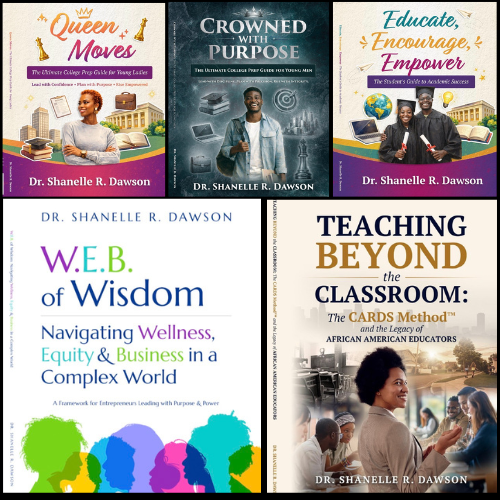
Teaching Beyond the Classroom: The CARDS Method™ and the Legacy of African American Educators
Available now on Amazon and at DrShanelle.com. The research foundation and practical guide behind every CARDS Method™ engagement — and the starting point for every educator ready to teach beyond the content.
To learn how the CARDS Method™ can address equity gaps in gifted and advanced programming in your district, contact:
Dr. Shanelle R. Dawson
DrShanelle.com
(800)803-2095
Educator | Author | Systems Thinker
Systems That Empower. Strategies That Last.
Every system starts with a decision. Every strategy starts with a purpose.