
Blog
The Discomfort Was A Signal. Here Is What It Was Telling Me
We spend so much time trying to fix our environments. The real work begins when we realize the environment is not the problem.
~Dr. Shanelle R. Dawson · W.E.B. with Dr. Shanelle · DrShanelle.com~
In the season after everything changed, I was uncomfortable everywhere.
In my home. In my work spaces. In rooms full of people I had known for years. There was a restlessness that followed me from place to place — a persistent, low-grade discomfort that I initially attributed to my circumstances. I had been through a great deal. Transition has its own texture. I told myself the discomfort was situational. That it would resolve when things settled.
Things settled. The discomfort did not.
And that is when I understood something that changed the entire direction of my rebuilding: the discomfort was not in the environment. The discomfort was in me. The environment was simply the mirror — reflecting back an internal state I had not yet fully acknowledged or addressed.
You cannot rearrange your way to peace. You have to recalibrate your way there.
You cannot rearrange your way to peace. You have to recalibrate your way there. The environment is not the problem. It is the signal.
What the Environment Actually Reflects
We talk about environment in wellness conversations as if it is primarily about the physical — the clean desk, the organized closet, the peaceful corner. And those things matter. But the W.E.B. Methodology™ treats environment as something larger and more honest than that.
Your environment is the full landscape of your life. The physical spaces you inhabit. The people you have allowed close. The energy you absorb daily. The conversations that fill your hours. The relationships that define your sense of self. All of it, together, is your environment. And all of it is either supporting your growth or quietly, persistently competing with it.
What I discovered in that season of rebuilding is that I had been so focused on the external disruptions — the losses, the transitions, the things that had changed around me — that I had not fully examined what I had been tolerating internally. The beliefs I had built my environment around. The standards I had accepted. The way I had organized my life around everyone else’s comfort at the persistent expense of my own clarity.
The discomfort was my internal knowing, communicating what my conscious mind had not yet caught up to: something here is not aligned with who you are becoming.
The Difference Between Rearranging and Recalibrating
Rearranging is what we do when we mistake the signal for the source. We move furniture. We change jobs. We end relationships and start new ones before we have understood why the old ones stopped working. We create new external conditions and carry the same internal state into them — and then wonder why the discomfort followed us.
Recalibrating is different. It begins with sitting with the discomfort long enough to ask what it is actually telling you. Not what it is convenient for it to mean. What it actually means.
For me, that meant acknowledging that my discomfort had nothing to do with the spaces I was in and everything to do with what I had been carrying inside them. The unexamined beliefs. The unspoken boundaries. The unmet needs I had been too focused on everyone else to name, let alone demand.
Recalibration required me to go inward before I could make any meaningful change outward. To understand what I actually needed — not what was easiest to want, not what required the least disruption, but what I genuinely needed in order to function, grow, and build with clarity — before I could begin to demand it from the environments around me.
Recalibration requires going inward before making any meaningful change outward. Understanding what you need before you can demand it from the world around you.
Learning to Demand What You Need
Demand is a word that makes a lot of women uncomfortable. We have been socialized to request. To suggest. To hint and hope. To make our needs palatable enough that others will not find them inconvenient.
I learned, in that season of rebuilding, that I had been doing all of those things — and that none of them had produced the environments I needed. Not because the people and spaces around me were incapable of meeting my needs, but because I had never clearly, directly, unapologetically named what those needs were.
The internal recalibration gave me that clarity. When I understood what I needed — the kind of space that supported focus, the kind of relationships that reflected possibility rather than limitation, the kind of energy that elevated rather than depleted — I stopped hinting and started requiring.
Not aggressively. Not with hostility. With the quiet, steady authority of a woman who has done the internal work and knows exactly what she is building toward.
Some people and spaces met that standard. Some did not. And learning to release what did not — without guilt, without extensive explanation, without waiting for permission — was one of the most significant acts of self-advocacy I have ever performed.
The Three Dimensions of Environment in the W.E.B. Methodology™
The W.E.B. Methodology™ addresses environment across three interconnected dimensions. None of them is sufficient alone. Together, they form the external foundation that makes internal growth sustainable.
Your Physical Space — The space that signals to your brain what is possible
Your study space, your workspace, your home environment — these are not neutral. A clean, organized, inspiring space signals to your brain that focused, intentional work is what happens here. Clutter, chaos, and digital distraction produce cluttered, chaotic, distracted output. This is not about aesthetics. It is about the conditions you are creating for your own cognition. A weekly environment reset — clearing, organizing, and resetting the physical space — is a business practice, not a housekeeping one.
Your Relational Space — The people who shape what you believe is possible
The people closest to you are environmental. They shape what you believe about yourself, what you think you deserve, and what you believe is within reach. A circle that reflects your limitations back to you is an environment that competes with your growth — regardless of how long those relationships have existed or how much history they carry. Deliberately building and protecting a circle of people who elevate your goals, celebrate your wins, and hold you accountable to your highest standard is not selfish. It is strategic.
Your Energetic Space — The inputs that shape your internal state
What you consume — the content, the conversations, the media, the noise — is environmental. It shapes your internal state before you have made a single decision about your day. Setting deliberate boundaries around your digital inputs, protecting your attention from distraction, and choosing the energetic inputs that support your clarity and focus are foundational wellness practices. Not luxuries. Requirements.
For the Woman Who Is Rebuilding While Finding Her Way
This week’s message is specifically for the woman who is doing both things at once — building something and still figuring out who she is in relation to it. Who has not waited until she has it all together to start. Who is in motion and in process simultaneously.
You do not need a perfectly curated environment before you begin. You need to start paying attention to what the discomfort is telling you. Because the discomfort is information. It is your internal knowing, communicating that something in your current environment is not aligned with where you are going.
Recalibrate inwardly first. Identify what you actually need — in your space, in your relationships, in your energetic inputs. And then demand it. Not aggressively. With the quiet authority of a woman who has done the internal work and knows exactly what she is worth.
The environment work is the beginning of the W.E.B. journey. It is the first dimension of Wellness — and it is the foundation on which everything else is built.
Start there. The rest follows.
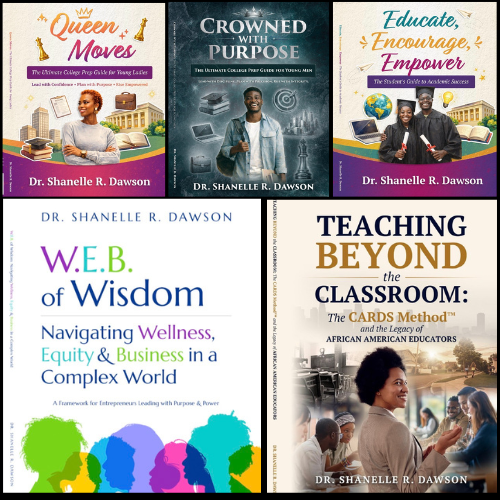
W.E.B. of Wisdom: Navigating Wellness, Equity & Business in a Complex World
Available now on Amazon and at DrShanelle.com. The complete roadmap for every woman who is rebuilding with purpose — starting with the internal work that makes everything external possible.
For consulting and speaking inquiries:
Dr. Shanelle R. Dawson
DrShanelle.com
(800)803-2095
Educator | Author | Systems Thinker
Systems That Empower. Strategies That Last.
Every system starts with a decision. Every strategy starts with a purpose.