
Blog
Academic Success Is a Strategy, Not a Feeling
We tell students they can do it. But do we hand them the tools? The story behind Educate, Encourage, Empower — and the framework that changed everything.
It started with a phone call.
In 2010, my son was in technical school for the military and struggling to pass his exams. As a mother and an educator, I did what came naturally — I got to work. I researched every academic strategy I could find, considered how he processes and learns information, built him a tailored set of tools, and sent it to him.
A few days later, my daughter — then in college — called. She had heard about what I sent her brother and asked if I could put something together for her too. I considered her learning preferences, built her a different set of materials, and sent those along. By the end of that week, she was calling back to tell me her friends wanted copies.
That moment told me everything I needed to know. Academic success is not a personality trait. It is not reserved for the naturally gifted or the effortlessly disciplined. It is a strategy — and the right strategy, matched to the right learner, changes everything.
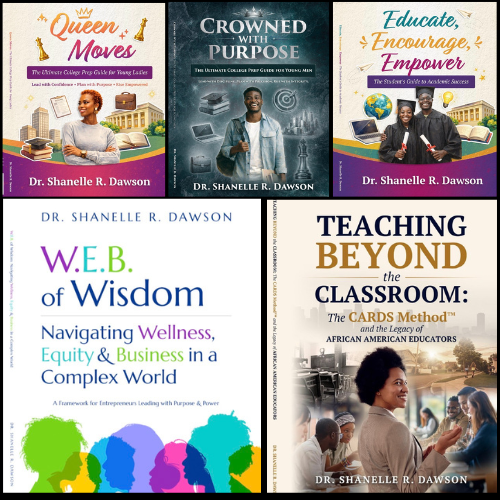
That is the foundation of Educate, Encourage, Empower: The Student’s Guide to Academic Success. And it is the principle I want to talk about today.
Encouragement Is Not Enough
We live in a culture that places enormous value on encouragement. We tell students they are smart, capable, and destined for great things. And they are. But encouragement without strategy is like handing someone a destination without a map. It feels good in the moment and produces very little movement.
What students need — at every age, in every academic environment — is not more cheerleading. They need a framework. They need to understand how they process information, what methods work best for the way their brain engages with content, and how to build study habits that are structured, intentional, and repeatable.
This is what separates students who perform from students who struggle — not intelligence, not effort alone, but strategy.
The Learning Preference Questionnaire
One of the most important tools in Educate, Encourage, Empower is the Learning Preference Questionnaire. Before any student can build an effective academic strategy, they need to understand how they process and learn information. This is the starting point — and it is one that most academic systems skip entirely.
While learning is not limited to a single style, most students have noticeable preferences. Some process information best when they can see it. Others retain it by hearing it, writing it, or physically engaging with it. Understanding your preference does not limit how you learn — it gives you a starting point for building a system that actually works.
The Learning Preference Questionnaire is the foundation. Everything built on top of it — including the PARADIGM™ Strategy — becomes more effective when a student knows where they are starting from.
Introducing the PARADIGM™ Strategy
The PARADIGM™ Strategy is a framework of eight research-informed techniques designed to help students retain and recall information more effectively. Each letter represents a distinct method — and together, they form a complete system for academic preparation.
PARADIGM™ stands for: Preparation, Acrostics, Relation, Acronyms, Diagrams, Imagine, Grouping, and Main Ideas.
Today I want to introduce you to the first two — because these two alone, applied consistently, can shift how a student approaches every exam, every assignment, and every learning experience.
P — Preparation
Think about how an athlete approaches a championship game. They do not show up the night before and hope for the best. They prepare — systematically, repeatedly, and in the specific ways that their body and their position demand.
Academic performance works the same way. Preparation is not cramming. It is structured repetition, applied using methods that align with how you process information best.
For visual learners, preparation looks like charts, diagrams, and color-coded highlighting — seeing the information in organized, spatial form. For auditory learners, it looks like reading notes aloud, recording content and playing it back, hearing the information as much as seeing it. For kinesthetic learners, preparation means doing — writing by hand, practicing problems, teaching the material to someone else. For reading and writing learners, it means rewriting, summarizing, and annotating until the information is deeply embedded.
Preparation is the foundation of the entire PARADIGM™ framework because nothing else works without it. You cannot apply a retention technique to information you have not yet engaged with repeatedly and intentionally.
A — Acrostics
The second technique is one of the most immediately useful in the entire framework — and one that most students have encountered without ever knowing it had a name.
An acrostic is a sentence built from the first letters of a list you need to remember. When information is placed inside a meaningful, memorable sentence, recall becomes significantly easier — because your brain stores meaning far more effectively than it stores isolated facts.
You almost certainly know one already. Order of Operations in mathematics: Parentheses, Exponents, Multiplication, Division, Addition, Subtraction. The acrostic: Please Excuse My Dear Aunt Sally.
That sentence has traveled through decades of classrooms because it works. It works because meaning improves memory. When a student creates an acrostic — or better yet, creates their own personalized version — they are not just memorizing a list. They are building a retrieval system.
This is what the PARADIGM™ Strategy does at every level. It does not ask students to try harder. It asks them to think differently about how they engage with information — and gives them the tools to do it.
Strategy Is Learnable
The most important thing I want every student, every parent, and every educator to understand is this: academic strategy is not something you are born with. It is something you learn. It is something you practice. And it is something that, once understood, can be applied across every subject, every grade level, and every stage of the learning journey.
My son went on to pass his exams. My daughter’s friends wanted their own copies of the materials. And eventually, those materials became a book — because what worked for them can work for every learner who is willing to build the right system.
That is the promise of Educate, Encourage, Empower. And it starts with understanding that success is not a feeling. It is a framework.
Educate, Encourage, Empower: The Student’s Guide to Academic Success is available here.
Dr. Shanelle R. Dawson
Educator | Author | Systems Thinker
“Every system starts with a decision. Every strategy starts with a purpose.”