
Blog
Why Legacy Is a System: What African American Educators Built
Title: Why Legacy Is a System: What African American Educators Built
Subtitle: The CARDS Method™ didn’t emerge in a vacuum. It was shaped by generations of educators who taught with purpose under pressure.
There is a particular kind of excellence that does not get celebrated in textbooks. It does not show up in the syllabi of most education courses or in the frameworks handed down from school boards and policy makers. But anyone who has been in the presence of a truly great African American educator knows exactly what it looks like — and more importantly, what it cost.
It looks like a teacher who stayed after school not because she was required to, but because she understood that her students’ success was not separate from her purpose. It looks like a principal who stretched a budget that had no business stretching, who found ways to expose his students to worlds they had been told were not for them. It looks like an entire community of educators who built systems — real, functioning, replicable systems — out of purpose, persistence, and an unshakeable belief in the young people in front of them.
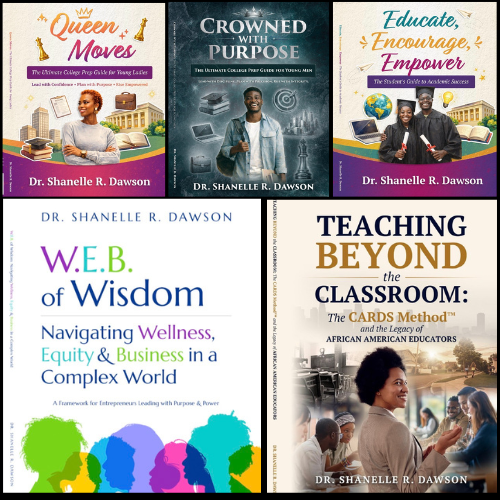
That is the legacy at the heart of Teaching Beyond the Classroom and the foundation upon which the CARDS Method™ was built.
Legacy Is Not a Memory. It Is a Blueprint.
We often talk about legacy as something we leave behind — a monument, a memory, a name on a building. But the educators who shaped generations of African American students understood something far more sophisticated. They understood that legacy is a living system. It is a set of practices, values, and frameworks passed from one practitioner to the next, refined over time, and applied with increasing precision.
The educators who built schools within oppressed communities— who created honors programs when none existed, who wrote letters of recommendation for students that systems had ignored — were not acting on inspiration alone. They were operating from strategy. From a deep knowledge of what their students needed and an equally deep commitment to providing it, regardless of what the system offered or withheld.
This is systems thinking. And African American educators have been practicing it for generations.
What the CARDS Method™ Observed
The CARDS Method™ did not emerge from a textbook. It emerged from observation — specifically, from watching what happened when African American students were handed a system that was not built with them in mind.
The miseducation of African American students is not a new phenomenon. It is a documented, persistent, and deeply damaging reality that shows up in discipline data, in gifted program enrollment, in graduation rates, and in the gap between the potential I have witnessed in classrooms and the outcomes those same students were handed. I watched it happen. And I watched master educators — the ones working in the tradition of those who came before them — find ways around it, through it, and beyond it.
The CARDS Method™ is my effort to name what those educators were doing. To take the wisdom embedded in their practice and make it transferable, teachable, and scalable. Every principle in the framework traces back to a legacy of educators who refused to let the limitations of a system become the limitations of their students.
What Legacy Requires of Us
Honoring legacy is not passive. It is not enough to acknowledge the educators who came before us, to include their names in a Black History Month bulletin board or a diversity training slide. Honoring legacy means doing what they did — building systems with whatever we have, for whoever is in front of us, without waiting for perfect conditions that may never arrive.
It means asking the questions those educators asked. What does this student need? What barriers are in the way? What can I build, right now, that creates a pathway? And then it means doing the work — consistently, strategically, and with the full understanding that what we build today will outlast us.
That is the legacy of African American educators. That is the system they built. And that is what Teaching Beyond the Classroom is committed to honoring, documenting, and carrying forward.
The Work Continues
When I wrote my dissertation, I knew it was not finished. Research lives in archives. Frameworks live in practice. My goal in adapting that work into Teaching Beyond the Classroom was to put something useful into the hands of educators who are doing this work right now — who are standing in classrooms, leading schools, and making decisions every day about how to serve students that systems continue to underserve.
The CARDS Method™ is for them. And it stands on the shoulders of every educator who built something lasting before any of us arrived.
That is what legacy looks like when it becomes a system.
Teaching Beyond the Classroom: The CARDS Method™ and the Legacy of African American Educators is available here.
Dr. Shanelle R. Dawson
Educator | Author | Systems Thinker
“Every system starts with a decision. Every strategy starts with a purpose.”