
Blog
Culturally Responsive Teaching Is Not a Program. It Is a Practice.
Districts invest in culturally responsive initiatives every year. The achievement gaps persist. Here is the difference between a program and a practice — and what the Advocate role in the CARDS Method™ does that no initiative can. ~ Dr. Shanelle R. Dawson
Culturally disconnected practice is not a resource problem.
This is the point most districts miss — and it is the reason culturally responsive teaching initiatives continue to underperform regardless of investment. The assumption embedded in most equity frameworks is that cultural disconnection is a function of underfunded schools, undertrained teachers, or under-resourced communities. Close the resource gap and the cultural gap closes with it.
That assumption is wrong. And it is expensive.
Black and Brown students experience culturally disconnected practice across every socioeconomic context — in under-resourced urban schools and in affluent suburban districts alike. A Black student in a well-funded district with highly credentialed teachers is not insulated from an educator who lacks the cultural framework to see them fully, advocate for them strategically, or connect their lived experience to the learning environment. The zip code changes. The cultural disconnection does not.
Cultural competency is not correlated with school budget. It is correlated with educator practice. And practice requires a framework.
Cultural disconnection does not discriminate by income. It discriminates by the absence of a framework. Black and Brown students in affluent districts are not exempt — they are simply less visible in the data.
What Culturally Disconnected Practice Actually Looks Like
It looks like a student whose home language, cultural traditions, and community context are treated as irrelevant to their academic experience. Whose history is addressed once a year. Whose identity is tolerated rather than affirmed. Whose behavioral responses to the world they actually live in are pathologized rather than contextualized.
It looks like an educator who sees a disengaged student and diagnoses a motivation problem — without asking what that student walked through before they arrived at the classroom door. Without understanding that the community outside the building is inside the student. Without the cultural awareness to recognize that disengagement is often a rational response to an environment that has communicated, through a thousand small signals, that this student does not fully belong here.
And it looks like a school system that has invested in culturally responsive programming — the workshops, the book studies, the consultants, the revised curriculum frameworks — while leaving untouched the daily practice of the educators in the building. Programs do not close cultural gaps. Practiced, daily, culturally grounded educator behavior does.
What Students Are Carrying Into the Building
An educator functioning without cultural awareness sees a student. An educator functioning as an Advocate sees a young person navigating a world that has been systematically working against them — and shows up accordingly.
That distinction matters because of what students are actually carrying.
Community violence is not an abstraction for many Black and Brown students. It is the lived context of their daily lives — regardless of their family’s income level or the neighborhood’s property values. A student who witnessed violence in their community last night, who is grieving a peer, who is managing the anxiety of an environment that does not feel safe, is not a discipline problem. They are a human being in crisis. And the educator who cannot see that — who lacks the cultural framework to recognize what they are looking at — will respond to the symptom and miss the cause entirely.
The school-to-prison pipeline is the institutional consequence of that missed recognition, repeated thousands of times across thousands of classrooms. It is not built by malicious educators. It is built by well-intentioned educators without a cultural framework — who respond to behavior they do not understand with removal, and who do not see that removal as the first step in a trajectory that leads somewhere catastrophic.
And the political landscape matters here too. Black and Brown students are living in a moment when the communities they belong to, the histories they carry, and the futures they are building are subjects of active political contestation. An educator who cannot hold that reality with empathy — who cannot acknowledge what it means for a student to exist in a world that is publicly debating their worth and their place — is not equipped to teach them. Not because they are unkind. Because they are culturally disconnected.
The school-to-prison pipeline is not built by malicious educators. It is built by well-intentioned educators without a cultural framework — who respond to behavior they do not understand with removal.
The Advocate Role in the CARDS Method™
The A in the CARDS Method™ stands for Advocate. And advocacy, in this framework, is not a personality trait or a professional aspiration. It is a daily strategic practice with specific, observable behaviors.
The Advocate challenges inequitable systems while maintaining professional integrity. They examine the referral patterns, the gifted program enrollment data, the disciplinary records, and the placement decisions in their building — and they do not accept disparity as inevitable. But the Advocate role goes further than institutional critique. It extends into the life of the student.
Advocate — The Full Scope of the Role
The Advocate helps students navigate outside social situations — finding resources, connecting families to support systems, and serving as the bridge between what a student needs and what the institution provides. They address community devastation through a lens of cultural awareness — understanding that what happens outside the building shapes what is possible inside it. And they engage the political landscape with empathy — acknowledging the lived reality of students who exist in communities whose worth and belonging are actively contested. This is advocacy as a complete practice, not a weekend workshop.
This is the educator who sees a student who has stopped coming to school and does not file a referral — they make a phone call. Who knows which families are navigating housing instability and connects them to resources before the crisis becomes a transcript. Who understands that a student processing community grief cannot be expected to perform as if the world outside this classroom is not happening. Who holds the weight of what their students carry without being broken by it — because they have the cultural framework to contextualize it rather than pathologize it.
That educator is not rare by nature. They are rare by training. The CARDS Method™ exists to close that gap.
Why Programs Fail and Practice Transforms
Culturally responsive teaching programs fail for the same reason discipline policy reforms fail: they address the surface without transforming the foundation.
A program gives educators a framework for understanding cultural responsiveness in the abstract. A practice gives educators the daily, automatic, transferable behaviors that allow them to act on that understanding — in the moment, under pressure, with every student, regardless of that student’s zip code or family income.
The distinction matters because cultural disconnection is not an event. It is a cumulative experience. It is the student who goes through an entire academic career without seeing themselves reflected in the curriculum, without having an educator who understood their community, without experiencing the particular kind of belonging that comes from being seen in full. That accumulation has consequences — in engagement, in achievement, in the decisions students make about whether school is a place that was built for them.
Reversing that accumulation requires more than a program. It requires a transformation of daily practice. And that transformation requires a framework that is taught, modeled, reinforced, and assessed — not introduced at a September professional development day and forgotten by October.
Cultural disconnection is not an event. It is a cumulative experience — built interaction by interaction, year by year, across an entire academic career.
What a Culturally Connected District Looks Like
It is a district where educators understand that Black and Brown does not equal at-risk. Where cultural identity is treated as an academic asset rather than an obstacle to navigate. Where the community outside the building is understood rather than feared. Where advocacy is a daily practice, not an occasional gesture.
It is a district where a student navigating community violence gets a counselor and a resource, not a referral. Where a student processing political chaos gets an educator who can hold that conversation with honesty and empathy, not silence and discomfort. Where a student from an affluent Black family in a predominantly white school receives the same cultural affirmation as a student from an under-resourced community — because the framework does not distinguish between them.
That district is not built through a program. It is built through the sustained, systematic development of educator practice. The CARDS Method™ is the framework that makes that development possible.
If your district is ready to move from culturally responsive programming to culturally grounded practice — that is the conversation the CARDS Method™ is built for.
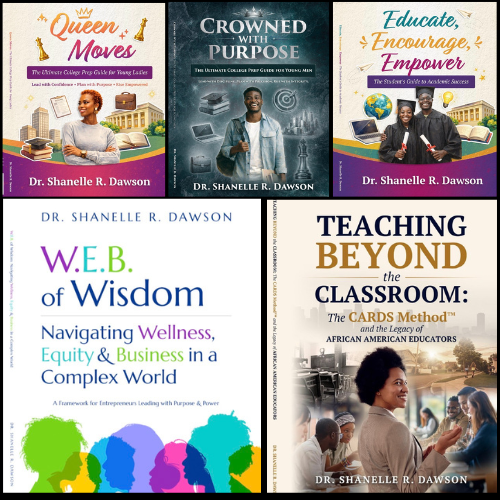
Teaching Beyond the Classroom: The CARDS Method™ and the Legacy of African American Educators
Available now on Amazon and at DrShanelle.com. The research foundation and practical guide behind every CARDS Method™ engagement — and the starting point for every educator ready to teach beyond the content.
To learn how the CARDS Method™ can address culturally disconnected practice in your district, contact Dr. Shanelle R. Dawson:
Systems That Empower. Strategies That Last.
Every system starts with a decision. Every strategy starts with a purpose.
Dr. Shanelle R. Dawson
Educator | Author | Systems Thinker
DrShanelle.com
(800)803-2095